

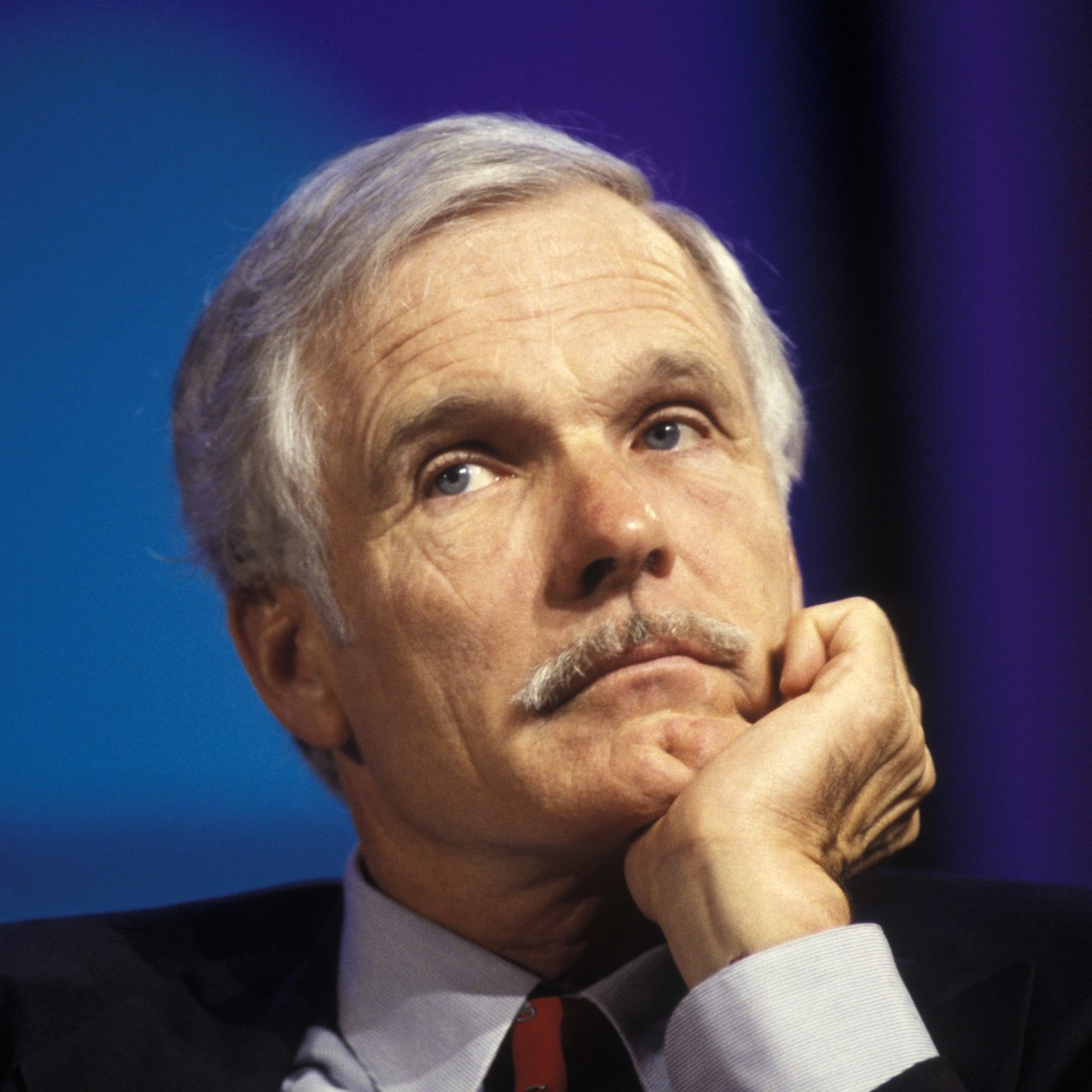
The media maverick who changed how the world receives its news passed away peacefully on Wednesday, May 6, 2026, surrounded by his family at his home near Tallahassee, Florida.
Ted Turner, the media maverick and philanthropist who founded CNN — the pioneering 24-hour network that revolutionised television news — died peacefully on Wednesday, surrounded by his family, according to a statement from Turner Enterprises. He was 87. His family confirmed that he died after a long battle with Lewy Body Dementia.
With his passing, the world loses one of the most consequential figures in the history of modern media — a restless, bold, and visionary man who dared to imagine a world where news never stopped.
A Difficult Childhood That Shaped a Giant
Robert Edward Turner III was born on November 19, 1938, in Cincinnati, Ohio, to Robert Edward Turner Jr. and Florence Turner. His father owned his own company, Turner Advertising, a lucrative billboard advertising business.
Life at home, however, was far from easy. Turner had a difficult relationship with his father, who had a weakness for alcohol and disciplined his son with a leather strap or a wire coat hanger. The family later moved to Savannah, Georgia, and his sister Mary Jean contracted a rare form of lupus when she was 12. The illness left her with brain damage and in severe pain for years until her death.
The experience of losing his sister so young, and the absence of satisfying answers from religion, deeply shaped Turner’s worldview and his lifelong drive to make the world a better place.
Turner was sent to several strict Southern military schools, and his father had hopes of him being accepted to Harvard. The young Turner enrolled at Brown University in 1956, but was expelled three years later, reportedly for having a woman in his dorm room. He then joined his father in the family’s billboard business, quickly rising to the position of general manager of a branch office.
Tragedy struck early. Turner was just 24 when his father shot himself and died in the upstairs bathroom at the family’s home near Savannah. It was March 5, 1963, and the elder Turner was under the influence of alcohol and pills, battling depression and worried he had overextended himself financially. Overnight, the young man found himself at the helm of a struggling company. Rather than folding under the weight of grief and pressure, Turner took over and began to build.
Marriage and Family Life
Ted Turner married three times and fathered five children across two marriages. Turner married Judy Nye in 1960. The two had two children together — Laura and Robert Edward IV (known as Teddy) — before divorcing a few years later.
Turner remarried in 1964, to Jane “Janie” Smith. The two had three children together — Beau, Rhett and Jennie — and were married for more than 20 years.
Turner married for a third and final time in 1991, partnering with the Oscar-winning actor and activist Jane Fonda. The union between an avatar of American capitalism and an outspoken progressive who railed against the status quo raised eyebrows, but the two were smitten from the start and bonded over their shared curiosity about the world. As Fonda once recalled, Turner was at his core “a little boy who likes to play, and who has wild brilliance.” The couple savoured their years together, spending countless hours in nature — hiking, fly-fishing, horse riding and other adventures — but the marriage ultimately ran aground, and they divorced in 2001.
His five children — Rhett Turner, Laura Turner Seydel, Jennie Turner Garlington, Teddy Turner and Beau Turner — all serve on the board of the Turner Foundation.
Building a Media Empire from the Ground Up
After rescuing the family advertising company from collapse, Turner set his sights higher. He turned the family business around and renamed it Turner Communications Group, then purchased two independent UHF television stations — in Atlanta and Charlotte, North Carolina — in 1970. He named them WTCG and WRET. WTCG eventually became WTBS, television’s first “superstation.”
In 1976, Turner made a strategic move to reach an even larger audience through the use of satellite technology. He rebranded once again, changing his company’s name to Turner Broadcasting Company. During the late 1970s, he conceived the idea for an all-news network.
The concept was radical, even laughable to many in the industry. Round-the-clock news? No sports. No entertainment. Just news, all day, every day.
June 1, 1980: The Day That Changed News Forever
On June 1, 1980, Ted Turner launched CNN at a converted Jewish country club in Atlanta. The world’s first 24-hour all-news cable network was born — and nothing in journalism would ever be the same again.
Turner had pronounced views himself, often of a liberal bent. But he wanted his station to reflect the news, not ideology. He thought human understanding across borders would benefit from reporting on stories and people around the world. His philosophy was simple but revolutionary: the news is the star, not the journalist. As one former CNN anchor recalled, Turner’s mantra was always, “You are not the star; the news is the star.”
CNN’s global footprint expanded rapidly. Cable News Network upended established broadcasting with around-the-clock breaking news and shot to global recognition with its coverage of the Gulf War in 1990–91. Those unforgettable night-vision images from Baghdad, broadcast live into living rooms across the world, announced to every government and citizen on earth that CNN was not merely an American channel — it was the world’s newsroom.
CNN is now a global news operation available to more than 2 billion people in more than 200 countries and territories around the world.
Revolutionising Cable Television Beyond CNN
Turner’s ambitions did not stop at news. As cable TV was revving up in the late 1970s and 1980s, he launched a wave of channels, including a nationwide reach for his cable station, Turner Network Television, and later The Cartoon Network and Turner Classic Movies.
In 1985, Turner used some of his profits to buy Metro-Goldwyn-Mayer (MGM), and in 1996, with Turner Broadcasting a leader in both the television and Internet industries, Turner sold the company to Time Warner for $7.5 billion dollars.
Beyond broadcasting, his purchase of an Atlanta UHF station in 1970 had begun the Turner Broadcasting System. He also turned the Atlanta Braves baseball team into a nationally popular franchise, including winning the 1995 World Series under his ownership, and launched the charitable Goodwill Games.
A Legacy Beyond Television
Turner was as extraordinary outside the studio as he was inside it. Turner famously gave $1 billion to the United Nations and co-founded the Nuclear Threat Initiative, a nonprofit advocacy organisation. He was also a prolific philanthropist, environmentalist, and self-described “do-gooder.”
As the years progressed, Turner created the Nuclear Threat Initiative to secure loose nuclear weapons in the former Soviet republics and elsewhere. He also gave widely to conservation and anti-global warming efforts. His philanthropy helped inspire the “Giving Pledge” of Warren Buffett, Bill Gates and other billionaires — and he was one of the first signatories to it.
The media mogul transformed American cable television by creating the first 24-hour cable news network. He was the man who proved that audiences not only wanted news around the clock, but needed it.
A Man the World Will Not Forget
CNN anchor Wolf Blitzer described Turner as “a legend who revolutionised the television business by creating the first 24-hour news channel.” Christiane Amanpour added: “He was the original. He made us all proud, he made us all hopeful, and he made us all strive for his vision of a better world.”
Even his long-time rival Rupert Murdoch was moved to pay tribute. “His impact as a trailblazer has left an indelible mark on our cultural landscape. He was a great American and friend,” Murdoch said.
CNN Chairman and CEO Mark Thompson summed it up best: “Ted was an intensely involved and committed leader, intrepid, fearless and always willing to back a hunch and trust his own judgement. He was and always will be the presiding spirit of CNN. Ted is the giant on whose shoulders we stand.”
Ted Turner did not just build a television channel. He redesigned the relationship between humanity and information. He democratised breaking news, shrank the world, and held the powerful accountable in real time. In an era of shrinking attention spans and fragmented media, his original vision — that the news belongs to everyone, everywhere, at every hour — remains more relevant than ever.
He was 87. He was one of a kind. And the screen has never been the same since he turned it on.
- Robert Edward “Ted” Turner III | November 19, 1938 – May 6, 2026